There are certain pursuits which, if not wholly poetic and true, do at least suggest a nobler and finer relation to nature than we know. The keeping of bees, for instance. --- Henry David Thoreau

"Well," said Pooh, "what I like best -- " and then he had to stop and think. Because although Eating Honey was a very good thing to do,
there was a moment just before you began to eat it which was better than when you were, but he didn't know what it was called. -- The House at Pooh Corner


Friday, June 25, 2010

Bait Hive Success


"I don't personally know any one who has caught a swarm in a bait hive here in my area, ..." I wrote last time.  Well, consider that statement as inoperative now. My first bait hive just produced the results exactly as I had planned it!

My friend with the big bee tree called yesterday. Her bees had finally swarmed out of the tree cavity! They had swarmed up to the place we thought they would go: under the eaves of her detached out building. This is where the bees went the last two times that colony swarmed. Some days ago we had placed the bait hive just in front of the now-closed-off opening into the dead space under the roof. The hive was now occupied!

I collected the swarm in the evening, when all the scouts and foragers had returned. It was a simple matter to stuff some paper into the opening in the bait hive, tape it over and then just remove the hive from the hook where it was hanging under the eaves. I carried the whole shebang over to my friend Julie's apiary and let her have them as kind of restoration of my karmic balance for that last swarm of bees she had delivered to me even though she had lost a queen. 

Any worries I had had about how to do the transfer from the bait hive to a permanent hive were erased.  It was a simple matter to unscrew the four deck screws holding hive closed, without having the whole thing fall open when the screws came out. Opening it up disturbed a few of the bees, but the cluster in the bottom half remained in place until Julie shook them into a western super she had already set up and made ready for the transfer. The swarm was mainly in the upper half so it was a simple matter to shake the rest of the bees into a space where half the frames had been removed from the super.  She set a white sheet on the ground next to the super leading up to the entrance. The loose bees and the flying stragglers just marched in. In a few minutes all the bees were at home in the super.

Julie put the remaining frames back in place and covered the super. In a day or two when they are acclimatised she'll do the newspaper trick and add them to an underpopulated hive in her apiary. When we looked into the now-empty bait hive, there were three saucer-sized combs already attached to the underside of the hive roof. They had built that much in less than 24 hours, and filled the combs with nectar and a fair amount of blackberry pollen!

I'm glad this whole plan came together, and I have high hopes now for the other two hives I have set out.  I'll keep you all informed.

[Added July, 2010: Some inquired, "What will happen to the queen if she combines the swarm with a colony????" It's okay, through the auspices of the Beek Association the queen got a new home.]


Sunday, June 20, 2010

Swarm Trap / Bait Hive

One of the things you'll probably want to try eventually is a swarm trap or bait hive. There are a bunch of different designs out there ranging from small boxes that are basically nucs, to the paperboard flowerpot style that are cheap and easy to acquire. You can even make them out of wastebaskets. They are not actually "traps", since the bees can come and go. It's just that you provided them a temporary shelter that's portable and allows for easy transferring of the swarm to a hive. You can bait an empty regular hive body as well, particularly if you have an extra  set up around your other hives when the colonies decide it's time to swarm.
 
I was looking around to try to find a comprehensive web page that had both pictures and a description of how to make one of those double flowerpot style bait hives that I have been using. There's not a good website yet, but there's a nice plan for this in The Complete Idiot's Guide to Beekeeping, on pages 66-67. I copied it and had pretty good success in construction.The single flowerpot style costs about $20 from beehive suppliers. My double flowerpot  swarm trap has a larger capacity, which is probably a positive factor for getting the bee scouts to choose it. (I suppose you could use just one flower pot and a piece of heavy cardboard or plywood for a cover.)  Whatever. There doesn't seem to be a good illustrative set of instructions anywhere handy that I can find; so I decided it ain't all that hard, I'll put instructions and pix here on the blog. Wall- la:

 It takes me about fifteen minutes to make one, but I'm gettin' old and slow.

Cost: The first one I built cost me about twenty bucks as well, including all the materials, but I made about 5 of them; so the cost averaged out to less than ten dollars. Not as cheap as that wastebasket hive up above, but still a pretty good value.

Materials: 
2 molded pressed fiber nursery pots 12"x11". Mine are 100% recycled paper and biodegradable.
[9/8/10 Note: I used big 12" pots since they seemed to offer the size of space bee-girl scouts like best, but I am beginning to think pots around 8" are perfectly fine and a bit easier to move about, and manipulate. Your choice, of course.]
1 Cable/Zip tie
4 1" outdoor deck screws or wallboard screws
1 can of foam weather sealant
1/2 pt clear sealer such as polyurethane


Tools
drill driver or screwdriver
small paintbrush
1 bottle of Foster's Beer (not shown)
 Instructions:
1. Invert one flower pot. Using drill driver or screwdriver, put two small holes an inch apart in the bottom center.
2. Insert cable/zip tie into one hole from inside, loop around and insert in other hole, slide tie end into lock end loosely, leaving an ample loop outside.


3. Place inverted pot onto rim of upright pot.  [9/8/10 Note: This is a good time to slip an old piece of comb into the bottom pot and maybe drip some lemongrass oil in too.] Using drill driver or screw driver, screw 4 deck screws through rims of pots, joining them together.

4.Place pots on their sides and fill 7 drain holes on top and bottom with spray foam. Remember to leave one opening on bottom pot for an entrance for the bees.
5. Hang bait hive/swarm trap in convenient work area. Allow sealant to dry.
6. Coat exterior with clear sealer. Allow to dry. (You can skip this step if your conditions are not super wet, the pots are fairly sturdy and water resistant)
7.Variations:  Smaller diameter pots would prolly work just fine, too. You can make small holes in the sides of the pots if you feel there needs to be more ventilation, depending upon how often you can check the swarm trap. If you dislike spray foam, you can plug those drain holes with anything -- wads of paper, chewing gum, putty, etc. You can also use a serrated knife to carve a larger opening in the bait hive if you suspect you're going to be inundated by the Mother of All Swarms.
8. Remove cap from bottle of Foster's Beer by twisting it off.  Consume contents at leisure, the project is completed. Repeat Step 8 as necessary.


I haven't found the exact right source of information about where and how to set up a swarm trap / bait hive, other than some reference to always keeping one near your hives so that you stand a good chance of capturing your own bees when they swarm. (9/8/10 ... I still haven't found much of a better source of placement information than the short two pages in Dean and Laurie's guide. Most links, like this one, say put the swarm trap about 8' up in a location where lots of bees are active, and where swarms have landed before [duh].  I'll keep lookin', but if you find a good source of swarm trap placement info, let me know, okay?)

So far I have had three of these hives out in various locations since about the end of May. It's been rainy and swarms are not quite so plentiful this year, so I have not had any results as of yet. My first bait hive is set up by the Bee Tree from last year's swarm captures. The other two are strategically located around the neighborhood and at the Eagle's Rest apiary. I'm thinking the grove of bee trees from last year's week o' the swarms might be an ideal location.  As for lures, I haven't acquired any of those pheremone lures they sell; I've just tucked a piece of old comb inside the swarm trap, and dribbled a few drops of  some really good lemongrass oil right inside the entrances.

Last year the Warré hive I baited and my small 24" kTBH never seemed to attract any action or interest from the bees, but I was more of a newbie then and less informed about the process. I don't personally know any one who has caught a swarm in a bait hive here in my area, although the different beeks on the 'net claim to have about 20% success rates. But what the hell, it's worth a shot, right?

Saturday, June 19, 2010

Easier Yet (almost)


In the last post I said, "But I doubt I'll soon get any more already boxed up and ready to go ... for free!"

Ya know, it's hubris to think you can predict the future with that kinda certainty. My friend Julie, sometimes known as 'the mentor bee lady who lives down the road', delivered a swarm to me, all boxed up and ready to go! What's better than that???

It was from the same farmer who had called me for the last swarm. He was working off the swarm list, I guess, to give away this second swarm too. Julie is the chief honeybee swarm rescuer in this part of our whereabouts. Normally she has every hive of her own populated, but she loves to save the swarms and to collect them for others. She knew I still needed to populate my last two hives, so she brought them to me. (A couple of long-time beeks have adopted the label "Lazy Beekeeper" on the 'Net, but with this delivery, I may be in the running for the title.)

Anyway, it was the same kind of big box o' bees, perfectly taped-up, with more little windows and everything. I figured, "Hey it's gonna be a snap! I'll just put 'em in the Biodynamic Lang the same way I did the others and let 'em settle in next to the Hard Luck Warré."

Sure.

Hubris, overconfidence, too easily thinking I'd graduated past "newbie"? It was a big unwieldy box and I was a little too careless in shaking them into the Lang hive. About half of them stuck to the side of the box and didn't quite slide out with the rest. I didn't notice this since I couldn't see over the side of the big box well enough. As I was pulling the box away the rest of them fell out onto the deck next to the hive. I had soaked them down pretty good with my water spray bottle, but still ... lots of them flew up, or they were all scurrying to find the rest of the colony. Next thing you know I am down on my hands and knees trying to grab them all in big handfuls and toss 'em into the Lang. (You would have laughed your ass off at the sight of me in my veil and helmet trying to see well enough to determine where they were crawling.)

Yes, I did have my gloves on, and that made it worse actually. First it was hard to feel them well enough to grab properly; and either I held 'em too tight or the bees just slipped out of my fingers. Second, about this time some of the honeybees decided they were through being Miss Nice Bee and crawled down in my gloves to sting some sense back into me. Owwww! Ow, ow, ow!

{Sigh} Eventually I got them all into the Lang, although I was a bit worried that the bees I had spilled included the queen - Julie had said she was a marked Golden Bee queen, two years old. I haven't seen her yet. I set up the entrance reducer, along with a piece of queen excluder I stapled over the hole to keep them from absconding and let them be for the night.

The next morning I went out early. The Hard Luck Warré had their bees out and foraging, lots of activity even though it was cool weather. The Biodynamic Hive had a few straggler bees wandering across the landing board but not much else happening. I snuck a peek inside and was at first pretty disheartened. There was a smallish cluster in the super, not nearly half of the about 5 pounds of bees I had put in there last night. Oh no! The queen hadn't made it into the hive! -- and the rest of the bees had struggled out of the entrance reducer/excluder barrier and had absconded in the night! I was an idiot! The queen had fled under the deck as soon as I spilt everybody!

I tilted the super up and looked in the bottom brood box inside the foundationless frames. Sure enough there was a half dome of sleepy bees covering the whole underside of the top bars, about the size of a basketball. Whew! Everything was copacetic!

I noticed that the bees that were moving in and out seemed to stack up for a long time at my makeshift reduced entrance, and I kind of don't trust that piece of excluder. In K&M's hive the bees just about refused to go through it. I headed off to Glorybee and bought another new plastic excluder and some frames for the western supers. When I returned, the sun had warmed up the Lang enough that the bees were moving in and out, albeit sluggishly. I removed the entrance reducer and slid the new excluder in, figuring a whole sheet of it on the bottom would be enough for them to comfortably get in and out and still leave the queen inside. Hey, there is something to this Langstroth standardization thing! The queen excluder fits perfectly on the rim of the bottom board, right under the brood box. I'd had to do surgery on the piece sitting under the Warré. This evening the Hard Luck Warré has foragers bringing in lots of bright orange pollen, some of it prolly from the California poppies on the roadside. Since this indicates the bee ladies seem to be occupying both hives permanently, I will slip both excluders out in a day or two.

Well, I learned what I learned from this; and tonight as the sunlight fades both the new swarms are active, bringing in pollen and sucking up the sugar syrup from the Boardman feeders I set up to keep them fed until they get some comb built and are viable on their own.

I said up above, "Normally [Julie] has every hive of her own populated." But she called me that night after she delivered the swarm, wondering  if I had hived it yet.

"Absolutely," I said, like it was no big deal at all.

Oh that was too bad, since when she got home one of her hives turned out to be queenless all of a sudden; and if I still had them in the big box she would have liked the swarm for herself to put in that hive with the queenless colony.  She regretted a little bit that she had given them to me. I offered to shake them back into the box, quietly rubbing my wrist where the stings were beginning to throb and itch. No no, that's okay, we'll just get another swarm. Am I still on the swarm list? Yep, and I am expecting the bee tree grove to swarm any minute. Although there were major swarm days in May, the timing here has been all over the place for bees this year. Every action, including the main nectar flow, is late in Oregon this year because of the rain. Some swarms are still bound to happen.

I will make no more predictions about how hard or easy the next swarms will be.

Monday, June 14, 2010

Easiest Swarm I Ever Got


A farmer called me via my entry on the LCBA Swarm List. He had a swarm, "Come get it."

I asked, "What equipment do you think I need? Should I bring my ladder?"

"It's in a box already."

I drove over to the most beautiful little farm area by Creswell. Sure enough there on the picnic table behind the house was a big cardboard box, all taped up. There were even little screen windows taped in place so the bees could breathe. Next time I fix up a cardboard bee box, that's the way I'm gonna do it.

The farmer told me he had 5 hives, but was moving and didn't want to start any more colonies. So when this swarm issued from one of his hives, he just called me as the closest beek on the swarm list. He slid the box off the table and carried it out to my car!

"How many times are you gonna get a swarm all packed in a box and ready to go?" he asked, laughing.

"Prolly never again," I admitted, and shook his hand. 

"They produce great honey, too" he smiled.

Me, I smiled too as I drove back home. I had "caught" a swarm dressed in shorts and a t-shirt, wearing flip flops. My part in the operation, minus drive time, was about 5 minutes. You know how there's usually some leak somewhere in a taped-up box full of bees? I drove home looking in the back every once in a while, expecting to see a few bees buzzing around the back window. But no, this farmer knew what he was doing. Every bee was securely inside the box.

I've decided to give the Hard Luck Hive another shot. What is this, the forth attempt? Anyway, I set the hive back up in that nice dappled-sun area by the greenhouse in my back yard. I put 3 boxes on the Warré hive, put on my veil and my gloves and opened the big box. It was big for a reason! There must have been five pounds of bees inside. After spraying them down a bit with water, I shook them into the upper box of the Warré. All around me the dryer bees flew up and buzzed around; but they were so docile that they didn't even pretend to be upset as I put the top bars back into place and fiddled around with the Warré quilt and roof assembly. No stings whatsoever this time.

Because there have been so many absconding swarms this year noted by newbeeks on all the lists, I've tried a trick from several experienced beeks who were posting to different discussion groups: If you want to avoid absconsion, use a queen excluder for the first few days until they start bringing in pollen. My Hard Luck Hive stand is constructed so that there is a raised rim between the lowest box and the bottom board. I placed the excluder over that rim and set the boxes over it, which hold it in place. Now the bees in K&M's kTBH hadn't been very easily able to go in and out through the excluder, but these gals just seemed to ignore it and right away started moving in and out as pretty as you please. I can easily remove the excluder by sliding it out in a few days. For right now, 24 hours later, the bees seem at home, making orientation flights and even sampling the borage blossoms in the back yard.

It's been a strange year for the bees here in Oregon: a cold snap right as Spring began, then a quick spell of sunlight, then almost constant rain from mid-March until just this weekend. Timing is off for everything related to the bees. Some beeks have even had to feed their bees well into Spring, according to Ken at the Beek Association. It seems to have delayed some swarming, because all of a sudden, like my box o' bees, the swarms are beginning to issue now that there is sunshine. There's no news from the grove of bee trees. But I expect they'll be swarming next. I'm looking to fill out the 'Biodynamic Lang' and the redwood Warré here very soon.

But I doubt I'll soon get any more already boxed up and ready to go ... for free!

Saturday, May 15, 2010

Swarm x 2


This is the time of year when all the bee blogs start posting articles on swarms and catching them. So, um, why should this blog be any different? Here's my report on "two at once":

Ed called me on Thursday 5/13 and told me that the City Bees and the Country Bees both had bunches of bees crawling around on the outside of the hives. He was concerned that they might be absconding. When I got there, sure enough ... the bees were gone. I was afraid he was correct until I looked in the hive windows and found there were more bees than ever! The last time I had looked was about two weeks ago and they appeared to be still the same remainder bees who had survived the winter. Since the plants were blooming all around, I just let them be to sort themselves out for Spring. In those two weeks they expanded their combs to double what they had before. The Country Bees had filled up their 30-inch kTBH hive to nearly 90 percent capacity. That's apparently the magic number for them, and they had swarmed.

The City Bees had grown in their 36-inch kTBH to nearly 75 percent. Ed had been watching when both of the hives just magically decided to take off at the same time. The City Bees headed for some trees to the right of those in the picture at the top of this blog. I went for a quick scout with Darwin, but the bees seem to have gone to a place deeper in the woods and weren't "catchable". There are lots of hollow trees in that grove, so both Ed and I were happy that they were going to populate his woods and add to the feral population. That's part of the whole sustainable natural beekeeping idea, right? I assumed both swarms had headed for the forest.

As I was packing up to go, I noticed a little group of bees flying in a cloud right over one of Ed's whiskey barrel planters in the garden. When I got up close I discovered a large - volleyball sized - cluster of bees attached to some dead stems of catnip from last year's bumper crop of Just the Buds catnip. It was the Country Bee swarm! In no time at all I had them in my yellow cardboard bee box. They were so docile I could pick up the straggler clumps with my hands and dump them in the box.  I left the box open a while to make sure all the flyers got back safe. When they were all inside I taped the box shut and headed to Karen and Maria's place. These would be enough for a large colony, perfect to replace those that had died out at the end of winter in their big 48-inch kTBH.

I couldn't believe how fast they took to the new home.  I shook them into the hive; and before I could get all the top bars back in place they were already making chains on the guides of the top bars and starting to sort themselves out and build some comb. These gals were ready!  I had put a piece of plastic queen-excluder over the entrance, since our experience last year was that bees would abscond from this hive easily. Watching for a moment, I observed that the straggler bees didn't seem to go into the hive easily and bounced against the excluder several times before giving up and trying to get in through the screened bottom. It seemed obvious to me that they were having too hard a time getting through the small openings. Since the gals inside were already moving furniture around and hanging drapes, I figured they were gonna stay anyway; so I removed the excluder and left them two open cork-holes to go in and out by.

It was a glorious Spring day. Up into the 70's. It's so interesting that both the hives would swarm within minutes of each other. I don't know the dynamics of all of this, but clearly the temp and the weather have a big influence on the timing of the swarms.

The Country Bee hive is still very near capacity and I don't doubt they will cast a secondary swarm out pretty soon. That's just great with Ed and me - and Darwin. Oh, I'm gonna put a bait hive out there, I have those new Warrés and that biodynamic Lang to fill yet this year. But if we populate those woods with bee colonies, that's a nice secret area ... safe from pesticide spray and any other man-induced fooling around.

Just right.

Tuesday, May 4, 2010

A "Biodynamic" Lang


In an earlier post I mentioned acquiring a Langstroth hive to add to my little apiary. The idea is to practice organic and natural beekeeping while retaining the advantages of standard beekeeping equipment. Last week, if I had had this Lang hive ready, I could have picked up a colony one of the local Beek Association members was removing. She was keeping all her woodware, just relinquishing the frames and the bees only. I don't want to miss an opportunity like that again.  Basically, now that I have at least one Lang hive, the next time a nuc is available, or a box o' bees, etc., I'll be set up to take 'em.

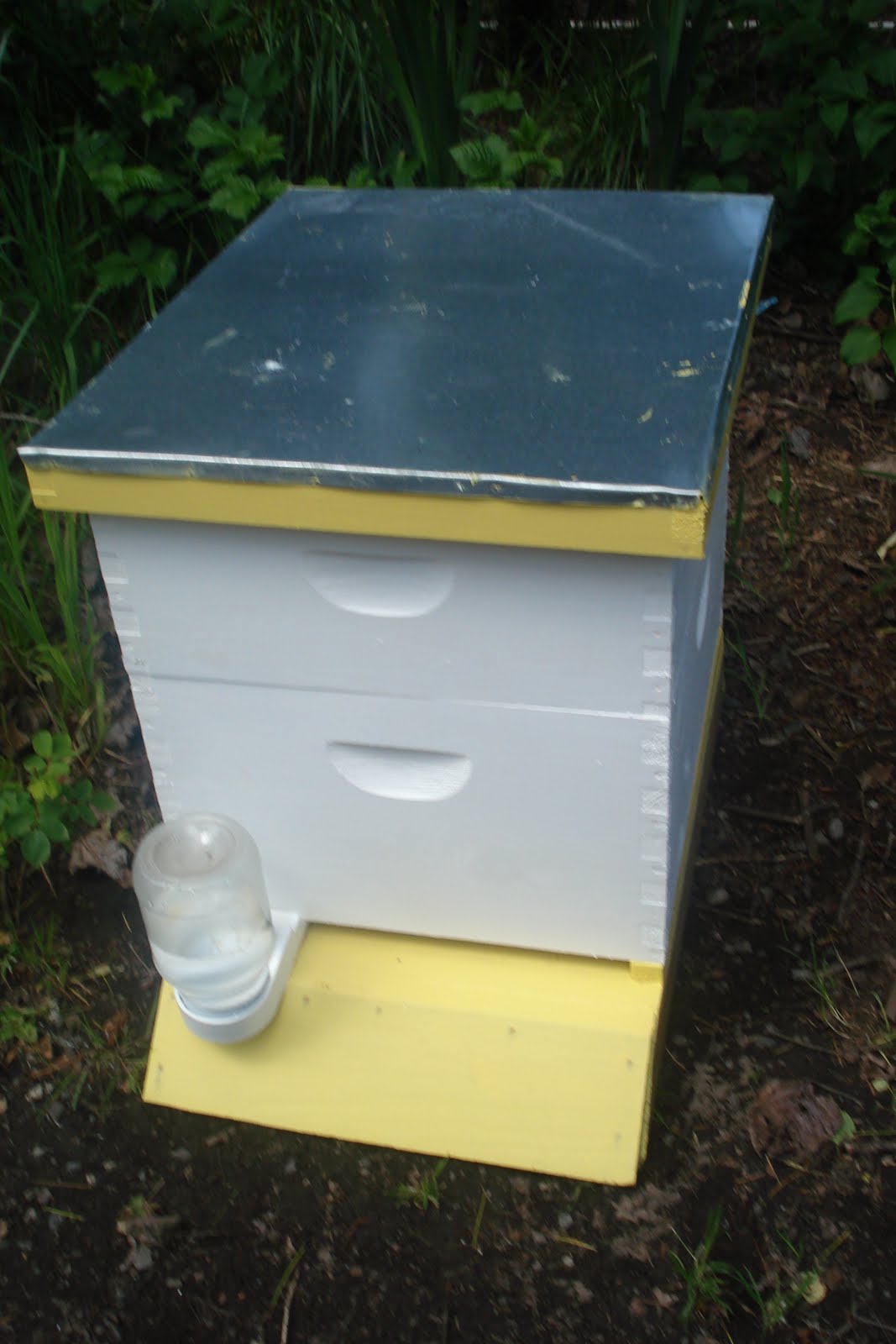
So, here it is, all painted with latex exterior house trim paint left over from last year's back porch remodel:

Inside, the frames are standard Lang-type frames, only there are no foundations --  I merely turned the top bar wedges sideways and fixed them in place with brads and some carpenter's glue. There are as yet not all that many places on the web to gather information on foundationless Langs, but this link is about the best place to get started.

This way the bees can build their own combs, their way. With all 10 deep frames for the brood, plus 10 Western or medium super frames above, the whole colony will have to produce a lot of their own wax, but this doesn't seem to be asking too much. Last year Ed's City Bees built a dozen combs on kTBH (Kenyan Top Bar Hive) top bars, and Karen's kTBH had a similar amount when we opened it at the end of winter. Ed's Country Bees were a very small swarm, yet by the beginning of winter they had built eight combs on their top bars too.

For the City Bees and the Country Bees, I had gone through that messy process of pouring melted beeswax in little slots cut down the center of the 1 1/4" top bars the way it's shown here. (Never again.) It's all nice and 3rd world-like in its simplicity; but it's not necessary after all is said and done. Using the popsicle-stick guide method, Karen's bees managed to build straight combs on all the top bars just as nicely.  Karen and Maria simply rubbed cake beeswax on the bottom edge of the top bar popsicle sticks. Since that worked out so well, I'm doing the same on the bottom of the frame wedges of this Lang. (Actually -- as you can observe -- I'm letting Dashel take over that job.)


This idea of using Langstroth hives in a more natural organic way is starting to be referred to as "biodynamic beekeeping" in the UK, and there's a whole section on it in the Biobees forum. "Biodynamics" has a little weirdness for baggage on account of Rudolf Steiner's bee lectures. You can learn all you need about that by going here. Another term for it here in the US is holistic beekeeping, and has been applied to several different variants of beehives.


Speaking of variants of beehives, I've added the "Biodynamic" Lang to my tiny apiary of  kTBHs and Warré hives, as shown here in my raised bed garden with my new redwood Warré. Both of these new hives have floors and stands integrated into one unit built with pressure-treated wood "feet" so the Oregon mud won't rot them. It's based upon the idea I posted in the links section, modifying the Ruches de Brunehaut French design.

So now I can make a split for a beek using Langs; or do any of those standard manipulations without rigging up a Frankenhive, or a bee Warré/Kenyan/Lang condominium or other setup.  To move bees into a Warré or kTBH it can be a simple matter then of brushing the bees into the hive, or using swarm catching frames -- modifying them and the combs to fit the kTBH or Warré hive shape of any hive in my apiary. Since I now have a Langstroth to receive the initial frames and bees, I can do this patiently, without any haste. And ... prolly more "biodynamic" Langs will come along eventually.
 
It's the first week of May, and here in Oregon reports of swarm captures are starting to trickle in. It won't be long now before those hives are occupied.

I hope your bees are doing fine.

Monday, May 3, 2010

On Not Being An Agent for Cruel Natural Selection ...


Over on the Organic Beekeepers Forum, there's another go-round about feeding our bees, what to feed them, what not to feed them, etc. Dee Lusby says don't never ever feed 'em sugar, feed 'em honey and don't cheap out. Fred says "allow" newbeeks who don't have much money to use sugar, just to get the honeybees started. The other regular forum posters take positions along the spectrum, mostly trying to stay in line with the ideology of sustainable, natural, organic beekeeping. The principle they are all working around is to not raise weak little bees who can't fend for themselves. Don't give in to anything that prevents evolution via natural selection from working its cruel magic in promoting only the fittest honeybees. Yep. Sure. Only ... the minute you took the bees and put 'em in your boxes, you disrupted whatever purity there was in that theory. (I won't 'splain that any further. You either get that concept or you don't.)

The same day I read part of an article about CCD which touched on this feeding issue. Here's a quote: "Now here’s a dilemma. If Mother Nature does not provide enough to eat for bees in an area, what’s a beekeeper to do? On one hand, a beekeeper can feed the bees sugar or corn syrup. But if he does, he is criticized for feeding an unnatural diet to these all natural creatures. But if he doesn’t, they die. You can make any choice you want based on any philosophy you have, but I won’t stand by and let my bees die if I can help it. I doubt any farmer would intentionally let his livestock perish if saving them somehow was possible."

Now there's danger in that approach as well (and again, you either get the concept or you don't.) but I'm thinking that in reality this is where most beeks are gonna end up in their decision making. It may be Natural Organic heresy, but it's prolly what's gonna happen, isn't it? So far, I'm going with this idea, at least to the extent of feeding them. I'm not gonna be the one to let 'em starve in the name of Darwin.

Just my two cents. (YMMV)